

Omnifin Framework
Omnifin’s 6Ps of Value Creation
A diagnostic framework for evaluating what drives the value of a business.
Overview
Omnifin’s 6Ps of Value Creation explains what drives business value. Business value is the present value of expected cash flows, adjusted for risk, and four levers determine it: growth, margins, capital efficiency and risk.
Financial statements report the outcome of these levers. However, they do not explain why one business sustains them and another does not.
Omnifin’s 6Ps of Value Creation is a structured way to answer that question. It classifies every material driver of business value into six categories: Product, People, Performance, Process, Planet and Plans. The framework is applied in Omnifin’s valuation, IPO-readiness and transaction assessments, and has been presented to practitioners at events and learning sessions.
In practice, it is built for three uses: founders and boards assessing the business they run, investors and acquirers assessing the business they are considering, and valuers and advisers building the qualitative case that sits behind a number.
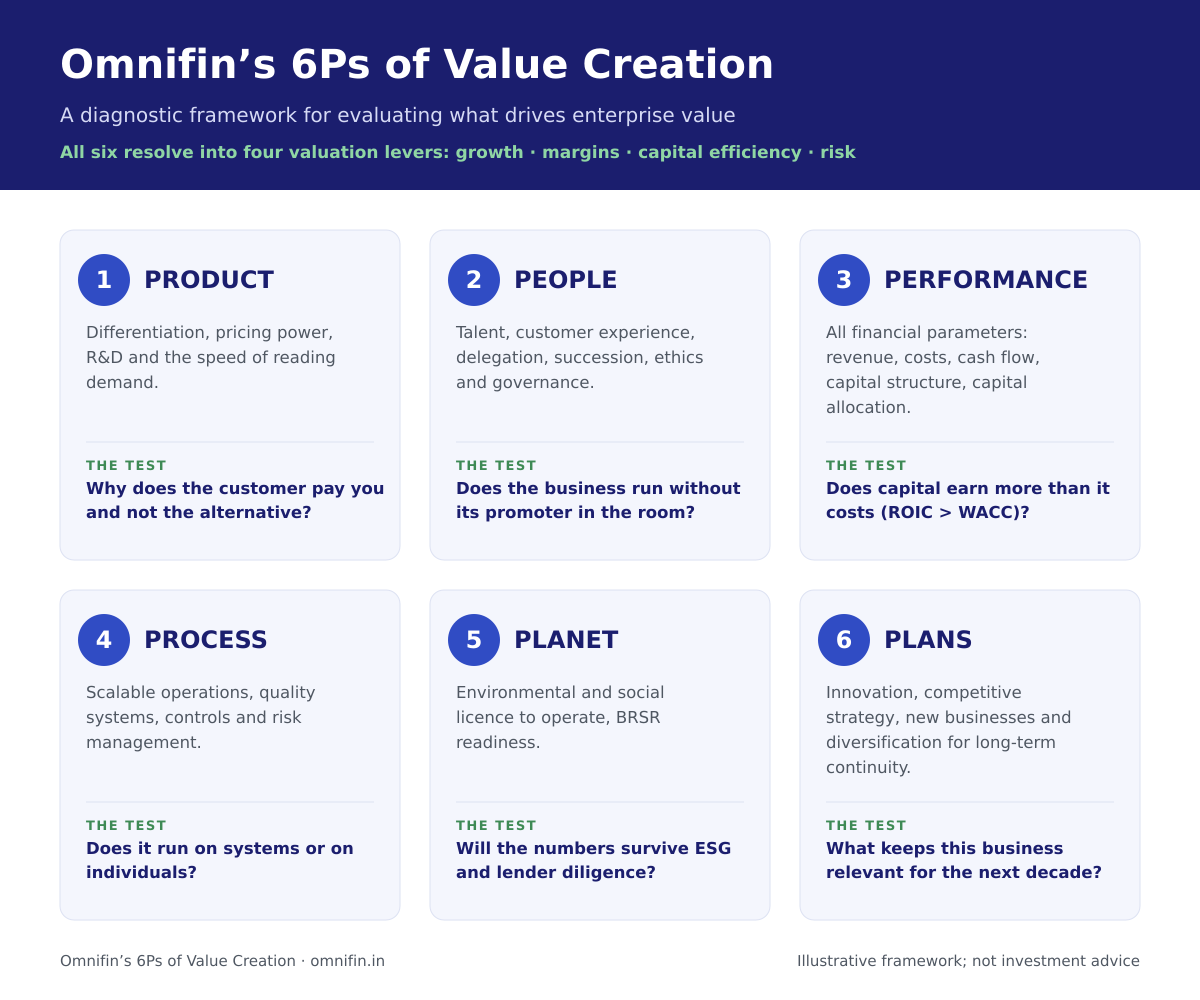
| P | Scope | Central question |
|---|---|---|
| Product | Differentiation, pricing power, R&D, responsiveness to demand | Why does the customer pay for this business and not the alternative? |
| People | Talent, customer experience, delegation, succession, ethics and governance | Does the business run without its promoter in the room? |
| Performance | All financial parameters: revenue, costs, cash flow, capital structure, capital allocation, return on capital | Does capital earn more than it costs? |
| Process | Scalable operations, quality systems, controls, operational risk management | Does the business run on systems or on individuals? |
| Planet | Environmental and social licence to operate, sustainability reporting | Will the numbers withstand ESG and lender diligence? |
| Plans | Innovation, competitive strategy, new businesses, diversification | What keeps the business relevant for the next decade? |
How the six categories are organised
The six categories are deliberately broad. Each acts as a classification bucket: any driver of value, however specific, belongs in exactly one. Product, People, Process, Planet and Plans describe the operating and strategic foundations of the business. Performance describes the financial result and the efficiency with which capital is deployed. A weakness in the first group usually surfaces in Performance later; therefore the framework is designed to find it earlier.
01Product
The offering and its position in the market: what is sold, to whom, and why customers choose it.
Value levers- Differentiation through features or brand
- Pricing power
- Investment in R&D
- Speed of reading and responding to shifts in demand
- If the closest competitor cut price by 10%, what would happen to volumes?
- Does R&D spend convert into products that carry a price premium?
- How quickly does the business detect and act on a change in customer demand?
02People
The human and governance foundations of the business: who runs it, who works in it, who buys from it and how decisions are made.
Value levers- Talent and employer brand
- Customer experience
- Delegation and depth of the second line
- Succession
- Ethics and governance: related-party dealings, board independence, audit quality
- If the promoter were unavailable for six months, which decisions would stall?
- Is there a documented succession plan for each critical role?
- Are related-party transactions at arm’s length, disclosed and approved independently?
03Performance
The financial result of the business and the efficiency with which it uses capital. Performance holds every financial parameter in the framework.
Value levers- Revenue. Quality before size: recurring and contracted revenue is valued above lumpy, project-based revenue. Diversified streams, pricing models and cross-sell sit here.
- Costs. Unit economics and operating leverage, more than one-off reductions.
- Cash flow. Working-capital discipline and conversion of profit into free cash flow.
- Capital structure. The aim is the structure that minimises WACC, not the absence of debt. Below the optimum, the business gives up the tax shield and its cost of capital can rise. Above it, financial risk raises the cost of both debt and equity.
- Capital allocation and return on capital. Value is created only where ROIC exceeds WACC. Growth below that threshold destroys value. Dividends and buybacks belong here; a buyback adds value only when the price paid is below intrinsic value.
- Does each incremental rupee of capital earn more than it costs?
- How far is the current capital structure from the one that minimises WACC?
- What share of revenue is recurring or contracted?
04Process
The systems through which the business delivers its product reliably and at scale.
Value levers- Streamlined and documented operations
- Quality systems
- Internal financial controls
- Operational risk: fraud, cyber, safety, supply chain
- How much of month-end close, pricing and quality control depends on one individual?
- Are internal financial controls tested, and are exceptions tracked to closure?
- Can operations double in volume without a proportionate increase in cost?
05Planet
The environmental and social conditions under which the business is permitted to operate and to raise capital.
Value levers- Environmental initiatives
- Workforce and community impact
- Readiness for sustainability reporting. SEBI’s BRSR is mandatory for the top 1,000 listed entities by market capitalisation, and assessment or assurance of BRSR Core extends to all of them in FY 2026-27. Banks, institutional investors and large customers increasingly pass the same questions down to unlisted businesses.
- Could the business’s environmental, safety and social data withstand third-party assurance today?
- Which customers, lenders or investors have begun to ask for sustainability disclosures?
- What regulatory or licence exposure does the operating footprint create?
06Plans
The forward-looking choices that determine whether the business remains relevant and resilient over the long term.
Value levers- Innovation
- Competitive strategy
- New businesses
- Diversification as a means of continuity and risk management, reducing dependence on a single product, customer, geography or regulatory regime
- What keeps the business relevant for the next decade?
- If the largest product or customer were lost, what happens to cash flows?
- Are new initiatives funded against defined milestones, or by default?
Linking the 6Ps to valuation
Each P acts on one or more of the four value levers. The weighting below shows where each category exerts the most direct influence. It is illustrative and varies by industry and stage.
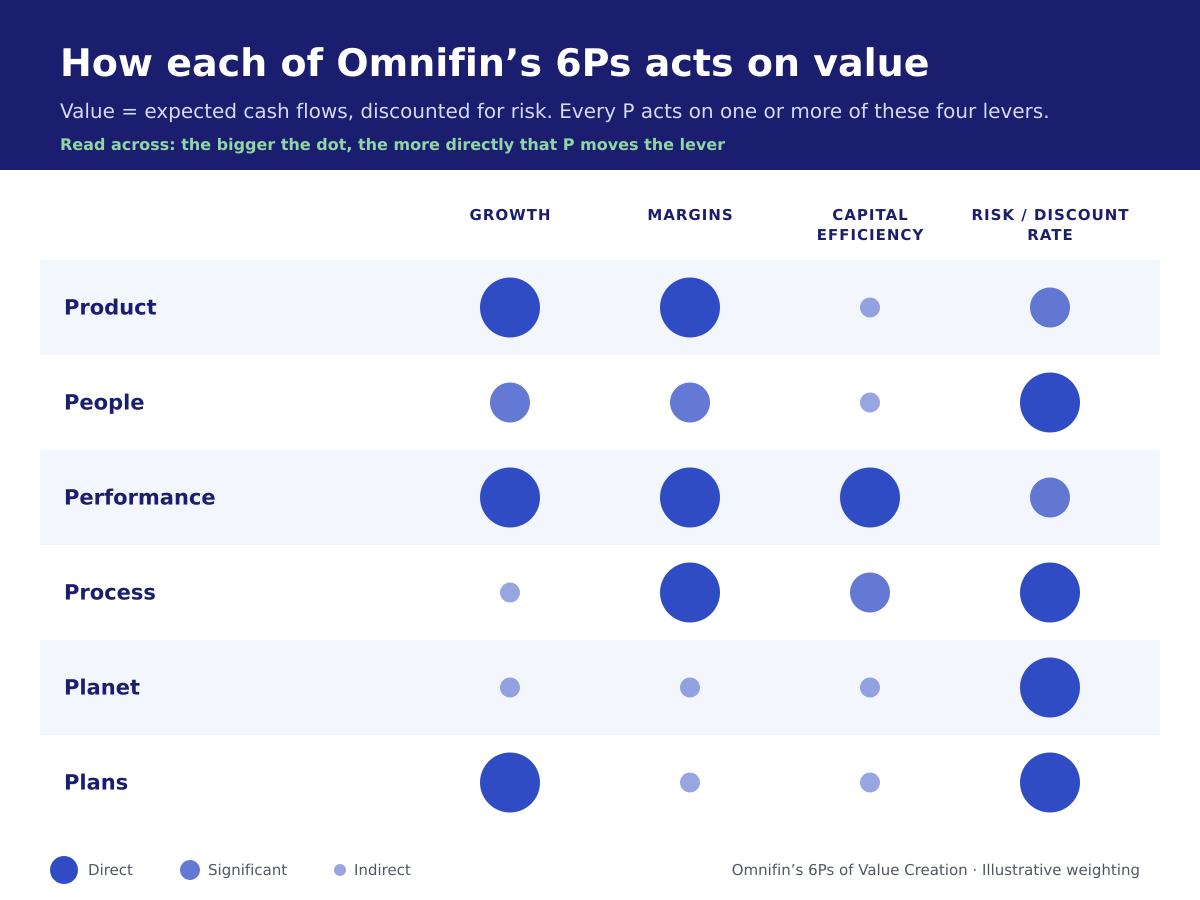
Performance is the only P that acts directly on growth, margins and capital efficiency together, because it holds the financial parameters. People, Process and Planet act chiefly through risk, and therefore through the discount rate. Product and Plans act chiefly through growth and durability.
Applying the framework
- Classify. Assign every material driver of value in the business to one of the six Ps.
- Evidence. Test the diagnostic questions against documents, data and management interviews, not against management’s description alone.
- Rate. Assess each P as a strength, a gap or a risk, and record the evidence behind the rating.
- Link. Trace each finding to the lever it moves: growth, margins, capital efficiency or risk.
- Prioritise. Address first the gaps that act on risk and on ROIC against WACC. These move value the most.
What destroys value
The framework is as useful for diagnosing decline as for building value. The recurring causes are:
- No succession plan, and decisions concentrated in one person (People)
- Weak ethics and governance: related-party transactions, aggressive accounting, poor disclosure (People)
- Short-term profit prioritised over long-term value creation (Plans)
- Capital deployed at returns below the cost of capital, or a capital structure far from the optimum (Performance)
- Dependence on a single customer, product or supplier that has not been priced (Plans)
Where it is used
Substantiates the qualitative judgements behind growth, margin and discount-rate assumptions.
An offer document must justify the issue price. The “Basis for Issue Price” section under the SEBI (ICDR) Regulations, 2018 places qualitative strengths beside quantitative metrics. The 6Ps organise the evidence for both.
Structures buy-side and sell-side assessments and identifies what to price or protect in deal terms.
A periodic diagnostic of the business, independent of the budget cycle.
Related reading
- 10 Factors Driving Valuation Premium and Discount
- What Is Business Valuation? Methods, Process and When You Need One
- Pre-IPO Valuation: Why Your Last Private Round Is Not Your IPO Price
Apply the 6Ps to your business
To discuss how the framework applies to your business, or to arrange a session for your leadership team, speak to Omnifin.
Prefer to write to us? Visit our contact page.
Cite as: Omnifin, “Omnifin’s 6Ps of Value Creation”, omnifin.in. Illustrative framework; not investment advice.